A Written Cue or an Object in View?
Compare a written cue with an object in view to choose a prompt that fits your attention, gives a clear next action and sits naturally in your space.

You sit at the kitchen table to answer a message, but your mind is still on the conversation you had earlier. A card beside your notebook says, “Feel your feet before replying.” A smooth stone sits in the same place. Each could prompt a pause, but they ask for different kinds of attention.
A written cue supplies words; an object relies on an association you have made. The choice is less about which is universally better and more about what helps you notice the moment and know what to do next.
Written cues name an action while objects rely on association
A written cue can state an intention plainly: “Look out of the window and notice one colour.” An object offers a reminder without spelling it out. A pencil placed across a closed notebook, for example, might mean “pause before beginning” because you have chosen that meaning.
Neither signal works by itself. You can read a note without taking it in, just as you can see a stone without connecting it to an intention. The useful prompt is one you recognise at the right moment and can respond to without much interpretation.
There is a difference between noticing a cue and following it. A note may catch your eye but ask too much of you; an object may be pleasant to look at yet leave its purpose unclear. Choose according to the kind of reminder that helps you move from seeing to acting.
A written cue helps when the next action needs to be clear
Words are useful when you want to define a pause precisely or distinguish it from other habits in the same place. “Feel one breath before replying” gives a clearer direction than a card that says only “pause”. Keep the phrase brief and tied to something observable, rather than asking yourself to reach a particular mood.
A note can be revised when your routine changes, and a paper diary or desk pad may make it easy to include one. But if you tend to scan past written material, another message on the same surface may become part of the background.
Choose words you will understand on a busy day. If the phrase needs explaining, simplify it.
An object works when its meaning already fits the setting
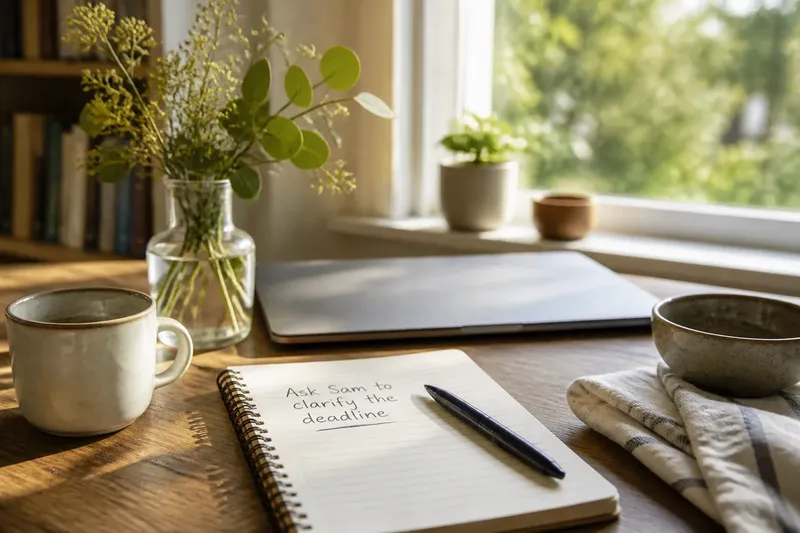
An object can be a comfortable prompt if you already associate it with a particular place or activity. A ceramic cup beside a book might remind you to settle into reading before reaching for your phone. The cup does not explain the intention; its position and the meaning you have attached to it do that.
Objects can suit someone who finds written reminders distracting. A distinctive shape or texture may be easier to notice among familiar things without adding another line of text. The drawback is ambiguity: if you have not decided what the object means, you may see it without knowing what to do.
Let the object point towards one small action, not an entire routine. If it blends into the surroundings, move it or choose something with a clearer visual difference.
Placement should connect the prompt to the moment you mean to notice
Put a cue where your eyes naturally go at the relevant transition, rather than somewhere it will demand attention all day. A note beside a laptop may suit the moment before work; an object near a favourite chair may fit a pause before reading. The aim is a useful connection, not constant visibility.
Consider the rest of the space. A bright note among a stack of papers may add clutter, while a small object among many ornaments may disappear. In a shared room, choose a cue that will not be mistaken for an instruction or a misplaced household item.
Say you often begin lunch while still thinking about a difficult conversation. You choose a card reading “Notice the first bite” and put it beside your plate. At lunch, you see the words and pause to notice the food before eating; if the card feels intrusive or you keep missing it, you move it to the place where you set down your cutlery. The expected result is a more recognisable pause, not an empty mind.
How do you choose a prompt for the situation?
Start with the problem you want the cue to solve. If you need instructions, words can remove guesswork. If you already have a strong association with an object or prefer less text in view, an object may fit better. These questions can help you make the choice:
Should I choose a written cue if I need a specific action?
Usually, yes: a short phrase can name the action directly and reduce guesswork. Keep it to one instruction you can follow in the moment, such as noticing your posture before starting a task.
Is an object better if I dislike reminders?
It may be, especially if an ordinary object already belongs naturally in the space. Choose something you can recognise without adding clutter, and decide what it is meant to bring to mind.
Can I use both a note and an object?
You can, provided each has a distinct purpose rather than repeating the same message. A note might state the action while a familiar object marks the place where you intend to pause.
What should I do if I stop noticing my cue?
Move it to a more relevant point in the routine or simplify its wording or appearance. If it still fades into the background, try the other kind of prompt or remove it; the cue need not stay if it no longer serves its purpose.
Small adjustments can show whether the cue fits
Change one feature at a time: the position, the wording or the object. Then notice whether the prompt appears at the intended moment and whether its meaning is clear. If you change everything at once, it is harder to tell which adjustment helped.
- If you see the note often but cannot tell what it asks, then rewrite it as one concrete action; if the wording is already clear, move it nearer the moment you want to mark.
- If you notice an object but its meaning does not come to mind, then choose a clearer association or add a brief written cue; if the association is clear but the object is easy to miss, move it into your natural line of sight.
- If the cue interrupts work at the wrong time, then place it at the transition before or after that task; if the interruption continues, remove it and choose a less intrusive prompt.
- If a note adds to a crowded surface, then move it to a quieter spot or replace it with an object; if the object would add clutter too, keep the cue in a diary you already use.
- If other people could mistake the cue for an instruction, then use a more discreet object or move the note to a private space; if its meaning still causes confusion, choose a different location.
- If the prompt feels like an obligation, then make the action smaller or take the cue away for a while; if the underlying intention remains useful, return to it when the setting suits it better.
For a written cue or an object in view, fit means more than being easy to see: the prompt should connect to a moment and make its next action understandable. Keep that connection simple, and let the cue change when your routine does.